In Important Election Year, APA Condemns Racially Charged Attack on Met BPA Chair And Backs National Black Police Association (NBPA) Presidents Calls for a National Discussion about Black Police Recruitment Boycott.
Date: Monday, 5th February 2024
The Alliance for Police Accountability (APA) strongly condemns the Metropolitan Police Service's (MPS) recent racially motivated misconduct investigation against the Chair of the Met Black Police Association (Met BPA), Charles Ehikioya.
This act of suppression highlights the systemic racism ingrained within the MPS, as revealed by the Casey Review in 2023, which found Black officers to be disproportionately subjected to misconduct investigations.
APA Chair Lee Jasper stated, "The MPS's targeting of the Met BPA Chair is an egregious attack on the campaign for racial justice in the Metand an extension of this government's phoney ideological war on the woke.
However, this year will see the Mayor of London and a general election take place. It's more crucial than ever for us to challenge systemic police racism. The MPS's weaponisation of the misconduct system against Black officers is unacceptable. It demonstrates the reality of a toxic policing culture of racism and discrimination that must be brutally confronted and completely dismantled."
In light of the upcoming Mayoral and General elections, the APA will be collaborating with a range of national Black organisations, including the NBPA, to demand greater action against racism within the MPS.
Jasper added,
"2024 is not just any year; it's a pivotal moment for us to hold the MPS accountable. The MPS year-old Turnaround Plan and the Mayor's Action Plan - now four years old - are deeply emblematic of failed and outdated policy approaches, filled with warm words and pious statements but with no substantive action or outcomes. We repeat ad nauseam that the MPS Commissioner's routine denial of the existence of institutional racism is a significant and fundamental blind spot, preventing any real progress."
The investigation into the Met BPA Chair, instigated after he highlighted senior officers' misconduct and the racism faced by colleagues, appears to be a concerted effort to silence a prominent voice for racial equality within the force. The restrictions placed on the Chair, including barring his involvement in discrimination cases and attendance at MOPAC meetings, are a clear attempt to silence black voices for racial justice.
The APA echoes the sentiments of Leroy Logan MBE, Janet Hills MBE, and Mina Smallman regarding the challenges Black police officers and activists face within the MPS. Andy George, President of the NBPA, has voiced a lack of confidence in the MPS's leadership to enact necessary reforms, suggesting a temporary halt on BAME recruitment into the MPS until significant changes are made. The APA believes this approach should now be discussed nationally among a range of national Black organisations as an urgent priority.
President of the National Black Police Association (NBPA), Andy George, said, "Given the crisis in confidence highlighted through so many incidents and reports, I cannot say that we can adequately protect and support officers of colour within the MPS. For that reason, I take the extraordinary step of saying that we no longer have confidence in the Commissioner or his senior leadership team to bring about the necessary and promised reforms to the service. I also regretfully recommend that anyone from Black, Asian and Minority Ethnic backgrounds do not join the MPS until there is more rigorous accountability placed on the Commissioner and more resources are given to the Met BPA so they can provide wrap-around support to those in need.”
The APA fully supports the NBPA's demands for an immediate end to the racially motivated investigation against the Met BPA Chair. We call for genuine, transparent reform within the MPS to eliminate systemic racism and restore trust in the communities they are meant to serve. As we approach critical election milestones, the APA, alongside our partners, will intensify our efforts in demanding a policing system that is fair, just, and accountable to all Londoners.
End of Release
About the Alliance for Police Accountability (APA): The APA is a coalition of activists, community leaders, and justice advocates dedicated to systemic reform within the policing system. Our mission is to ensure fairness, justice, and accountability, promoting a policing culture that respects and protects the rights of all communities, particularly those historically marginalized and oppressed by systemic racism and discrimination.
Her home was raided by a SWAT team all because of a toy gun. Hear firsthand in this exclusive in-depth interview the horrific trauma suffered by Mina Agyepong, her 12-year-old son Kai and her two daughters as they were held at gunpoint by Metropolitan Police Service
Unbelievably, and despite all that she and her family have been through, she has received no formal apology from the Met.
We also ask why @Unilever is brutally exploiting Kenyan tea plantation workers and farmers and has monuments depicting enslaved Africans outside its London HQ?
Here is the full video. broadcast of the recent Lambeth Police Consultative Group meeting held on Thursday 23rd of January 2014 that took place at the Karibu Community Education Centre Gresham Road Brixton , Lambeth , London.
The meeting was called in response to recent Mark Duggan Inquest verdict that concluded that Mark was lawfully killed but in a perverse twist of logic, further determined that Mark was not in possession of a gun, despite the evidence of the Police Officer who shot him, who told the court that as Duggan spun to face him, described as a " freeze frame " moment he was staring down the barrel of a gun.
The verdict has widely but not universally been condemned as " perverse " and the implications for British policing are profound. In short a police officer can, according to this verdict, lawfully shoot anyone as long as he has a reasonably held belief that the individual is carrying a gun.
Set against the context of a Metropolitan Police Service that has, since the Commissioners and the Mayor of London' s bizarre conclusion that the MPS are no longer an institutionally racist organisation, witnessed the rampant return of unchecked institutionalised racism, that has produced increased levels of a range of racial inequalities.
For example huge increases in the use of Stop & Search, increases in race complaints about officers, racism in the charging of black and white first time offenders that taken together demonstrates conclusively that the MPS is directly falsely criminalising London black communities in a profoundly unjust and deeply oppressive manner.
I am of the opinion that we now need to boycott any Police Service that does not accept that reality of institutional racism and agrees to work in partnerships with communities to rid themselves of this disease. Partnership mean genuine accountable representation from communities, not hand picked nodding dog negroes.
This demand must be elevated to a national priority if we are to stem the precipitous political decline of the priority accorded to equality and anti racism. My thoughts are as follows;
To end all non essential contact with Police Services that do not, publicly and formally except that they are a institutional racist organisation.
To call a national boycott of all black police recruitment to the police and until such time.
To publicly challenge anyone individual or organisation that seeks to work with the police whilst they refuse to accept the reality of institutional racism.
My rationale is that until the Police accepting they remain a racist organisation then we are likely to see;more racist policing incidents,
more suspicious deaths in custody,
more disproportionate use of Tasers on black people,
more black people being unjustly charged when they should be cautioned,
more black officers leaving the force than joining and as a result
more likely to see further explosions of violence on our streets sparked by any number of possible catalyst trigger policing incidents.
Better a boycott now than riots later.
So I intend to argue this case urging a national policing boycott to prevent the further criminalisation of our children, secure a drastic reduction in the number of all suspicious deaths in police custody, curtail the oppressive use of Stop and Search and the discriminatory use of all policing powers, and argie for radical changes to the the policing discipline regulations to sack racist officers.
I hope you will work with me to secure decent future for all our children.
Boris Johnson: race equality is not important in his world
London is the most ethnically and religiously diverse city on the face of the planet. As we prepare to welcome people from all over the world to the London Olympics they will be greeted by a city that is a vision of the future.
London is the world in one city and visitors can expect to find communities, food, and religious beliefs representing the four corners of the globe. In an increasingly globalised world more major cities will begin to look increasingly like London.
That hyper racial and cultural diversity so readily apparent on the meandering streets of London, so resplendent in its dynamic multiculturalism that helped London win the 2012 Olympic Games, fascinates and beguiles peoples coming from drab monocultural societies. This multicultureality is part of London’s distinct charm and appeal.
However that most remarkable smiling cultural dynamism seen on London’s streets and markets instantly disappears once you enter the po-faced, formal and stiff neo Victorian world of the City of London. Nowhere is this contrast sharper than in the areas of the financial service sector and London governance.
Here we enter the almost culturally exclusive world of wealthy white men where diversity is looked upon as exceptional, where those therein look more like the Britain of the 1950’s: old male pale and stale.
As anxiety around the country about the state of our economy grows with every passing day and the Euro zone threatens to end the world as we know it, the media reports schizophrenically and simultaneously on the continuing economic crisis, the Queens Jubilee, Euro Championships, Wimbledon and now the London 2012 Olympics.
Whilst the diversity reflected on the streets of London, will be also be reflected within the national Olympic athletes teams, by the spectators from around the world, once one enters the City of London and London governance that diversity instantly vanishes.
London’s commitment to equality and diversity in employment and politics is revealed as mere tokenistic window dressing.
The Mayors Office, the London Assembly, the City of London Corporation, London Government Association, Local Councils and the halls of high finance in the city, resemble a racial hierarchy, a cultural exclusiveness, an ‘old boys’ club that is resolutely white and male.
In a city like London these circumstances are a recipe for disaster and discord. Such huge racial divides and the distinct lack of diversity in the corridors of power and influence pose a serious threat to the city.
African, Caribbean and Asian descendant communities amongst an international cohort of refugee and asylum seeker communities are growing in number and are becoming deeply alienated by the huge racial disparities in terms of their reducing life chances and dearth of opportunities.
There is a huge and growing difference between wealthy white London and the majority multicultural impoverished London. This is a city divided by deep economic, structural racial disparities that are becoming more entrenched as the economic crisis continues.
The Olympics, we are told by the Prime Minister David Cameron, will bring £30m billion into the London economy. I can confidently predict that London’s Black and Muslim communities will not benefit from the huge injection of cash. Trickle down economics never ever reached these communities in the boom times.The word in the black community is that in economic terms we are all black now as people who have enjoyed years of white privilege in the city are introduced to the black experience of increasing rates of unemployment and poverty.
As the media focuses on the issue of the continuing financial scandals of the Square Mile, across inner city London the hot smoldering embers of economic and social injustice burn bright.
We saw these embers ignite as the issue of deaths in police custody and an acute sense of injustice acted as the spark that promoted the riotous disturbances of August 2011. This profound crisis and the reality of a deeply divided city remain largely ignored. The mass of black and poor people in London have been left to fester and ferment.
The media and press, whose pressrooms rarely include any black journalists and whose limited understanding of racism is derived from their own superficial experiences and infects their perspective on race issues, news stories and editorials results in distinct racial bias in news reporting.
How many black reporters senior or otherwise are there at the main media companies such as the London Evening Standard or LBC Radio?
This lack of diversity in the media finds its mirror image in London’s Mayoralty. After 8 years the Mayor Boris Johnsons team of senior advisors does not reflect London. This results in serious policy weaknesses that relegates the political priority accorded to racial equality policy.
Compounded by the ideological Tory mantra that refuses to recognise difference and racial disadvantage in terms of policy I see the consequences as tensions continue to build.
Policing is a good example of the fundamental political weakness that sits at the heart of London governance.The Mayor of London Boris Johnson has radically transformed the notion of Police accountability in the Metropolitan Police Service.
The MPS is the largest police organisation in England and Wales, and has a leading role in national and international policing. It has a workforce of around 50,000, including 32,000 police officers and 4,000 police community support officers. It serves a city with more than 7.6 million residents and 1.1 million daily commuters. 10% of Met officers are from an ethnic background, which is significantly less than the 40% that would be representative of the London population. They have no significant representation in the Commissioners Senior Management Team that has become increasingly white over the last four years.
As the Mayor Boris Johnson signaled that he has no serious commitment to the issue of race equality so the MPS reverted to its monocultural default setting that has seen the return of rampant and resurgent levels of unrestrained institutional racism.
Critical to achieving a police service that is informed by the principle of policing by consent and is reflective of London’s diversity is the constant and relentless political pressure needed to ensure even the most modest progress is made.
My experience whilst responsible for Equality policy in Ken Livingstone’s administration is just that. We applied massive pressure to ensure equality policies were prioritized and even where these policies were agreed and adopted, we found we had to forensically monitor progress on a monthly basis to ensure progress.
Boris Johnsons lack of political and policy commitment to race equality acts as deadweight on effective policy innovation and implementation.
Constant pressure is required and in the absence of that, the police culture eats equality policy for breakfast.Boris Johnson has barely paid lip service to race equality. His Race & Faith report examining the barriers to recruitment, promotion and retention of Black officers declared that the MPS was now free of institutional racism.
This was a fundamental and catastrophic error as the catalogue of police racism cases of late has revealed. The awful truth is there are thousands of similar cases where the victims having no faith in the discredited MPS complaints process choose not to make a complaint.
During the last year, there have been significant changes to the MPS leadership and governance arrangements, with the arrival of a new Management Board and the transfer of responsibilities from the 23-member Metropolitan Police Authority (MPA) to the Mayor’s Office of Policing and Crime (MOPAC).
The new Policing Commissioner for London, Deputy Mayor Stephen Greenhalgh, seems psychologically unsuited to the job and has already dismissed the London Assembly Police and Crime Committee as an irrelevance. He has no experience of operational policing and even less experience of race and policing issues. His appointment will be, I predict, a disaster for London.
The old MPA was the most diverse police authority in the UK. During its first four years the majority of the MPA members selected by our administration were Black or Asian.
The MPS had the highest number of senior Black officers of any force in the UK.In City Hall and the GLA the majority of senior employees in the top 5% band of salaries were Black. Whilst on the boards of London organisations and institutions where the Mayor had nomination rights, we selected more Black and Asian people onto those boards than at any time since the demise of the GLC.Examine these institutions today after four years of Tory administration and Black and Asian representation has been reduced to tokenistic levels. This trend exemplifies the deliberate and calculated ethnic cleansing of London Government. The consequences of this for London have been profound.
The August riots of 2011 were avoidable and the reality is that the Mayors failure to ensure a diverse team in City Hall and the MPS cost London dear and will do so again if not remedied soon.
Despite Boris’s undoubted popularity, ideological hostility to race equality does not come cheap.It has to be recognised that these costs will become greater as alienation increases.
Public sector cuts, all supported by this myopic Mayor has seen black unemployment jump to astronomic levels currently running at 56%. We are suffering a “Greek” style economic crisis right here in London.
This should alarm and appall all right thinking politicians and citizens. The consequences are profound and will, if left unaddressed, plunge London into a spiral of conflict, crime and civil disturbances.
The policing of the riots and the sentences handed out to rioters is contrasted in the minds of London’s excluded communities with the lack of action on MP’s expenses, bankers bonuses and the billions of pounds stolen as result of white collar crime. The Libor scandal is a case in point. It is clear that grand fraud has taking place on an unprecedented scale and yet not a single person has been arrested.
There is an increasing view that the MPS no longer polices black communities with consent and that there is one law for the rich and wealth and another for the poor and black.
The Stephen Lawrence Inquiry report recommendations have been abandoned, the forensic monitoring structures dismantled. If that was not bad enough now we hear that Boris is about to abolish groups such as the Lambeth Consultative Groups established as a result of the Scarman Inquiry into the riots of the 1980’s.Based in London boroughs these are key community consultative forums that hold police to local account. Anyone can walk in off the street, join, get elected and the next day be talking to their local Borough Commander or the Commissioner.
Groups like the one in Lambeth offer a key forum for challenging police malpractice, informing local policing strategies, challenging institutional racism and allows for a vital channel for communication between the police and local communities. Lambeth is legendary in that regard and has a long and distinguished record of raising issues such as stop and search, deaths in custody, use of police informers and challenging gun and knife crime.
Boris is going to get rid of these groups and replace them with a new body that will have no accountability and will be handpicked by the Mayor and local police commanders.
Having eviscerated all progress on the Lawrence report, Boris now seeks to attack the legacy of Scarman. It is a scandal and no amount of cheery bonhomie, quirky Latin quotes and ruffling of hair can hide the fact that this Mayor is intent in dismantling all real accountability for policing outside the confines of City Hall.
It is vital that these fundamental weaknesses in City Hall are addressed now. Post Olympics we will see massive cuts to the policing budget. £769 million – the amount the MPS will need to save between 2011 and 2015 3,280 – the number of posts the force plans to cut by 2015. 1,410 of these will be police officer posts 1230 PCSO’s Police Staff 640.
This will leave local forces unable to effectively tackle crime in the context of growing unemployment and massive rise in the levels of poverty.
Boris’s ideological hatred of race equality and his commitment to implementing austerity cuts will leave Londoners facing future disturbances that will cost the city millions, and the poor and vulnerable will be doubly victimized as they are left over policed as result of racial profiling and under protected as a result of the decline in the economy and increased rates of crime and violence.
I sent a letter to Commissioner Howe requesting the immediate arrest of Bob Diamond under the Fraud Act 2006. You can see it here....
Commissioner Metropolitan Police Mr Bernard Hogan Howe New Scotland Yard London SW1
Thursday 5th July 2012.
Re Financial Services Authority report into Barclays fixing of Libor and Euribor interest rates.
Dear Commissioner Howe,
I write this open and public letter to make a formal criminal compliant about Barclays former Chief Executive Bob Diamond, his senior management team and other employees who during the period between 2007 and 2009, at the peak of the global banking crisis, fraudulently filed artificially low Libor and Euribor rates resulting in the defrauding of billions of pounds of public money. I believe that these actions constitute serious criminal acts as defined by the Fraud Act 2006. The potential scale of this criminal act of fraud demands that the MPS Serious Fraud squad, in the interest of justice, immediately secures all relevant evidence and without delay arrest all those suspected of being involved with immediate effect.
The lack of action to date by the MPS Serious Fraud Squad is inexplicable and is sharp contrast to the effort, resources and commitment of the MPS to prosecute individuals alleged to have taken part in the disturbances of August 2011 sparked by the shooting of Mark Duggan.
The vigorous approach adopted by the MPS to arresting suspected rioters and the sloth like response to an extremely serious crime that could potentially affect millions of individuals and companies alike, defrauding them of potentially billions of pounds, illuminates the policing priorities of the MPS. There is, as you know, a body of growing public opinion that believes that there is one law for the rich another for the poor.
It is in the public interest that arrests are made and additional evidence secured quickly if public confidence in the unbiased equal application of criminal law for all citizens regardless of status or wealth is to be regained.
Lord Justice Mansfield in the case of enslaved African seeking freedom James Somerset in 1729 said “ Let justice prevail even although the heavens may fall.”
I urge you to end the prevarication of the MPS on these matters and enforce the law of the land. Yours sincerely
Lee Jasper Co Chair of BARAC Black Activists Rising Against the Cuts UK
With over 50 complaints made to the MPS in two months, condemnation of police racism is no substitute for action
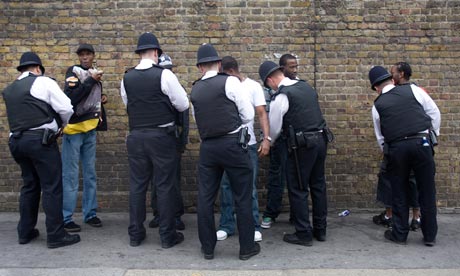
Police stop and search black youths at the entrance to the Notting Hill Carnival in 2008. Photograph: Gideon Mendel/Corbis
The disclosure that as many as 51 allegations of racism were made to the Metropolitan Police Service (MPS) in the two months after 1 April should come as no surprise to anyone who is familiar with the Met's track record of institutional racism. It is difficult for a leopard to change its spots just because a Lord says it should. If the period from April to June is representative of a general trend, this may mean that we'd be looking at an average of over 200 complaints per year, which in itself would only be the tip of the iceberg. As with all aspects of racism, the real figure is certainly a lot higher.
The term "institutional racism" was always a very generous term from the outset. It allowed senior management to claim that there was little or no direct racial discrimination. The reality has always been different. Human beings sadly do differentiate on grounds of race, gender and class in making their everyday decisions. The police are no exception to this general behavioural tendency, but the danger is that given the pressures of their jobs, mere racist prejudice is more likely to result in racist actions than with other members of society.
Police officers have overlooked the development of a culture in which being African Caribbean, and more recently Asian and Muslim, was of itself a cause for suspicion. The disparity in the MPS stop-and-search figures, exceeded only by the Solicitors Regulatory Authority (SRA) in disciplining rates for black and minority solicitors, suggests a deep cultural psychosis.
The reaction of senior management today is to scramble to deny the problem, and is a widespread one reminiscent of the "few bad apples" comments made famous years ago by former commissioners defending the MPS.
Johnson recently claimed that "we've moved on" from the term "institutional racism", first defined by the Macpherson report, adding that "I think great progress has been made but there is more to do". This strongly suggests he fails to grasp the seriousness of the issue and warrants some analysis as to who the "we" are.
The mayor may have been referring to white people in power and authority like himself and his former deputy mayor Kit Malthouse, which would explain why so few of the recommendations of the Race and Faith report of 2010 still had not been implemented.
Racism flourishes when permitted to do so. There is clear evidence that the leadership of the MPS, which is still horribly white, these days does not have race central to its core business objectives to eradicate or reduce. Words of condemnation are no substitute for action. The actions against racism are far less vigorous in practice.
In its wider responsibility neither the mayor of London nor the MPS sought to maintain the work of theLondon Race Hate Crime Forum organised under the former Metropolitan Police Authority. This body, which was able to scrutinise hate crime on a borough basis, was effective in increasing the sanction detection rateof hate crime, doubling up from a low of 19% to 38% in 2008.
Yet it was effectively abandoned and the responsibility returned to the old system, which always lacked effective scrutiny and accountability – despite the fact that in London last year there were over 8,000 racist incidents reported to the MPS as compared to 10,000 reported some three years ago. This is almost certainly an indication that the general public has less confidence to report racist incidents to the MPS than it did some years ago. It almost certainly does not mean that racist incidents have fallen by 20% in the last three years, as some would suggest.
There is inevitably a synergy between the fight against race and religious crime and the internal problem of the MPS. Black and minority communities are less likely to join an organisation seen as soft on race and the same community will think long and hard before reporting racist incidents to a police force with a racist ideology among a significant minority. The real answer lies not in the one officer who utters racist comments but in his colleagues who pretend not to hear. That is the culture that has to change.
MPS Commissioner’s commitment to rooting out discrimination called into question after reports that he reinstated ‘ racist’ officer.
The commitment of the Commissioner of the Metropolitan Police Service to tackling racism is being called into question, as sources within the MPS provided evidence that he had previously reinstated a police officer accused of racism.
There is already widespread disenchantment from Met police officers who are desperate to challenge the racism of their colleagues but who doubt the commitment of senior officers, including the Commissioner to take real action.
MPS Police Commissioner Bernard Hogan Howe, while he was an Assistant Commissioner with the MPS, overturned a decision to sack a police traffic officer (who had been reported by a fellow officer) for racially abusing a black man whilst on traffic patrol in London.
It is said that having been overtaken by a black man with dreadlocks the officer forced the man to stop before delivering a volley of racist abuse. The man was not arrested or charged with any offence. A fellow officer in the police car at the time was so shocked by the severity of the abuse that he reported the incident to his senior officers
At a subsequent internal disciplinary hearing the officer was found guilty and it was recommended that he be sacked with immediate effect. The officer appealed against the decision and that appeal was then heard by the then Assistant Commissioner Bernard Hogan Howe. He overturned that decision citing the fact that although the officer had some 15 years in the job he had not had any ‘ race relations’ training.
With the Commissioner having responded to recent cases highlighting the racist behavior of his officers by setting out his total commitment to opposing racism, this case will call into question that commitment. Reported in the Guardian, the Commissioner made public his commitment to tackling racism within the police service.
He stated:
"I will not stand for any racism or racists."
Adding,
"We have a duty to challenge or report any behaviour by colleagues which is less than the high standard demanded by the service and Londoners themselves," he said. "You cannot avoid that duty. Nor can I."
That commitment must now be called into question as a result of what appears to be his personal decision to overturn the decision taken by fellow officers to sack the PC concerned.
Questions need to be asked about how many MPS officers found guilty of racism through the MPS disciplinary process have been subsequently reinstated?
Further there must be full disclosure of how many times similar decisions were personally taken by Commissioner Howe whilst employed at the MPS and as Chief Constable for Merseyside?
With the MPS in the grip of a ‘race crisis’ this new evidence will seriously call into question the Commissioner’s personal and professional commitment to tackle racism in the MPS.
With the trust and confidence of London communities rocked by recent revelations and a now growing crisis of confidence of officers within the Met the situation is becoming critical.
This is just one of a series of cases not yet in the public domain that will emerge over the coming weeks, that is bound to further damage the beleaguered reputation of the MPS with Londoners.
The notion of policing by consent is the cornerstone of British policing. It is a cardinal rule in politics that the political and operational independence of the police should remain resolutely sacrosanct in the maintenance of this important principle. British police still remain scarred by the effects of the 1908’s Miner strike where they were seen as acting in support of the political agenda of Margaret Thatcher. Talk to senior officers about that time and it is clear that this episode still leaves a bitter taste in their mouths.
The obvious danger for the police is that their authority as impartial enforcers of the law becomes deeply compromised when they are seen to act politically.London has seen the deracination of these important two important principles under the Mayoralty of Boris Johnson and his Police Commissioner Kit Malthouse.
The revelations that Kit Malthouse tried to reign back the police inquiry into phone hacking, not once but on at least five different occasions, is further evidence of this growing culture of the attempted politicisation of the police.The evidence given to the Levenson inquiry is explosive and reveals the extent to which relations between the Mayors Office and Scotland Yard have deteriorated.
What we have heard during the inquiry in relation to the Mayors Office is unprecedented. The serious public criticism of Boris Johnson and Kit Malthouse by former or current senior MPS officers is simply staggering. (Lord Blair, Sir Paul Stephenson, Commander Cressida Dick to name but a few).
The MPS are a cultural and political institution and at a strategic level they operate like an Empire of old. No entry into the field of politics is considered without much discussion and meticulous preparation. This stellar line up of officers, all singing the same tune is no coincidence. I believe it reflects a decision by some current and former senior officers at Scotland to fight back against the partisan political influence of Boris Johnson.
The Mayors lack of political vision and inability to grasp detail means he is incapable of seeing past his own narrow electoral interest. Policing needs politicians who act as statesmen/women who understand the strategic importance of maintaining public confidence and ensure they keep their political distance from on going specific policing inquiries.
The importance of upholding the principles of operational independence and maintaining public trust and confidence in the police cannot be overstated. Boris Johnson and Kit Malthouse treat these important issues with a stupefying level of arrogance and a casual disregard that is reckless.
Trust and confidence in the Metropolitan Police Service among Black, Muslim communities and young people has declined to an extraordinarily low level. I have not seen relations as bad as this since the widespread civil disturbances of 1986.
The political demand for huge increases in stop and search rates were demanded by the Mayor in response to the level of violence among young people. Whilst he oversaw massive increases in the blanket use of the power, he spectacularly failed to deliver his flagship youth projects aimed at diverting young people away from violence and crime.
As a result he created the conditions where alienation and anger at the police increased to the extent that young people decided that was no one really cared if they lived or died and that the police who were swarming their communities were the enemy.
The Mayors right wing politics render him blind to the effects of racism and black youth experienced increased levels of criminalisation as a result. The recent broadening of the remit of Operation Trident from its niche focus around black gun crime to “gangs” provides further evidence. Seeking to reinforce his 4-year record of failure in tackling youth violence he demanded that Trident now become an anti gang unit. The implication is clear and unambiguous: London’s gang problem is synonymous with black communities.This political co-option of Trident is a disaster, the consequences of which are profound.
The Mayors political agenda not only propels him to interfere in areas of operational policing where he has no business, he also finds himself absent on issues where he should be front and centre.
The August riot over the shooting of Mark Duggan is a case in point. Where were the Mayor and his Deputy when the very sinews of the relationship between the MPS and black communities were at snapping point?
The London riots could and should have been avoided and the Mayors dismissal of racism led him to conclude that all was well despite repeated warning that relations were at “boiling point” from a broad range of influential black people. Boris Johnson failed in the most dramatic way costing both London and the country millions of pounds as a result of riots that tragically saw loss of life.
Riots could have been avoided
This is his most heinous crime: the malign neglect of the issue of police and black community relations in London.
What we now know is that Kit Malthouse engaged in what can only be viewed as an on going campaign to derail the MPS hacking inquiry. I recall the time when I was falsely accused of unduly influencing the London Development Agency and the subsequent headlines and political comment. We faced fierce and unrelenting criticism about the “undue political influence” of Mayoral advisers.Those accusations were proven to be nothing more than political opportunism; a racially and politically motivated smear campaign.
In contrast Boris Johnson’s serious and fatal political errors born of unrestrained arrogance and ambition attract no such outrage, manufactured or otherwise.Kit will have to resign, as the reality is that he has now lost all credibility among senior MPS officers who have conspired to hang him out to dry at the Levenson inquiry.
His position is untenable. He is though, deserving of some credit, in that he has managed the quite remarkable feat of uniting both MPS and London’s black community in their open and trenchant criticism of him and his boss.
When Boris Johnson assumed control of the Police I wrote that he would come to regret that decision. The dangerous unrestrained Mayoral ambition to control the police was foolhardy. As Boris examines the approaching Mayoral electoral horizon, no doubt he will note that the sky is dark with chickens coming home to roost.
George is now recovering at King's College Hospital
(Evening Standard)
The police have shot yet another black man. The black community across London has reacted with anger and disbelief as the last vestige of trust and confidence in the Metropolitan Police Service slowly ebbs away. Others and I have repeatedly warned of the lethal deterioration of the relationship of police and black communities in London. That issue should concern everybody and focus the minds of both politicians and police officers on this potentially explosive and parlous state of affairs.
In today’s political culture the reality is that the issue of race equality is being deliberately and routinely ignored. This ideological blind spot on serious and difficult race issues extends to Government, the Mayor of London and the weakened and enfeebled Greater London Assembly who are supposed to hold to account the Mayors newly created Mayors Office for Police and Crime. No currently elected representative is speaking out on these issues and that is symptomatic of profound and acute failure that results from ethnically unrepresentative democratic institutions in a multicultural city.
What happened to this young man? Well the facts as we know them are that on Sunday the 19th February, a young Ghanaian man just 25 yrs of age was reported as being suspected of breaking into a car. He was reported as having a knife and after failing to comply with officer requests to drop the knife and surrender he was contained and completely surrounded by armed officers.
What followed is subject to an investigation by the Independent Police Complaints Commission, but what we now know was this young Ghanaian had been both tasered and shot multiple times by armed officers. He is reported to be in a critical but stable condition.
At a sober public meeting called in the aftermath by *Metropolitan Police Service (publicised by the Lewisham Police Consultative Group) held on Saturday 25th February, the level of anger and concern was palpable.
Chaired by MPS Commander Zinzan, sitting alongside him was Lewisham Superintendent Jeremy Burton and Mike Franklin of the IPCC were in attendance along with others. This had followed a quickly arranged public meeting held on Monday 17th February where Commissioner Hogan Howe himself attended. That’s encouraging and should be welcomed, but the obvious question is where is the Mayor at a time of crisis?
Given that the Mayor is now solely responsible for the police and having endured the riots of last year, one would have thought he would be front and centre on this issue.You have to ask the question where is the Mayor at a time when London’s community police tension indicators are flashing red?
Once again the Mayor is absent at a time of crisis, is silent when London needs clear leadership and strong reassurance. This callous indifference to the needs and concerns of black Londoners is the Mayor’s most fatal flaw. The result is a Mayor that is dangerously out of touch with the London’s black communities. The consequence of this acute political failure to understand the multicultural nature of the capital is that community and police relations continue to spiral dangerously out of control.
This latest incident represents a new nadir in the long and controversial history of black people and the police. What took place on Saturday gives an insight into the current state of these relations and you can see what happened at the meeting here.
The packed meeting heard from local eyewitnesses who stated that they witnessed scenes of chaos with police officers running around, shouting and screaming and seemingly out of control. People spoke of how the man in question lay completely naked in sub zero temperatures surrounded by officers with no one giving him any medical attention.
Others spoke of their real and genuine fear that, had they intervened, they too would have been shot. More spoke of the widespread fear for young black men who come into contact with the police with one elderly grandmother telling the police: “I’m afraid for my grandchildren. We are living in fear”.
Commander Zinzan responding to a question from the floor stated that “the MPS does not have a shoot to kill policy. Instructions to officers are to shoot to stop”
An eyewitness said that the press reporting of the young man being in possession of lots of knives did not tally with what they saw. The told the meeting that there was only one knife.
Another reported how she had argued with officers who had prevented a nurse from attending to her sick mother.Another insightfully cited the case of Raoul Moat who went on a killing rampage and finally shot himself after a 6-hour standoff. This was presented in stark contrast to the treatment of the young Ghanaian, given that Moat posed a much more serious threat to the public.
Others complained that no real answers about the critical questions could be answered given the ongoing investigations. Some felt that this left a dangerous vacuum of information, particularly in the current context where trust and confidence is absent.
After repeated assertions by the Police that the young man in hospital was potentially dangerous and would be subject to immediate arrest once he was fit enough, others commented that police seemed more interested in interviewing the victim rather than the police officers involved in the shooting who had not yet been interviewed. It is left to officers to declare when writing their notes if they have spoken to colleagues. Police officers can then choose whether they speak to the IPCC or not or provide a written statement. The Officers spoke of the officer’s ‘trauma’ of having to shoot someone.
The police were then dramatically challenged a number of times about the constant harassment of family friends and visitors visiting the young man in hospital by police officers. Their answers were frankly abysmal.
First suggesting that a man in intensive care may abscond, then under challenge stating that the hospital welcomed their presence, an officer told the meeting that to imagine a “gang scenario” where a victim’s life may be under threat.
At this point the meeting erupted in anger and disbelief.
A key point was made by a member of the audience that pointed out there are high definition Transport for London cameras that would have caught the incident. This was confirmed by the IPCC who reported that they had reviewed the videos. This could be crucial evidence in determining the events that took place that cold Sunday morning in Lewisham.
Let us not forget that August 2012 saw some of the worst civil disturbances ever seen on the British mainland. The cost to London was and continues to be enormous. First and foremost we saw the tragic loss of life that ensued including that of Mark Duggan in Tottenham. We watched the smouldering embers of the ruined and burnt out shops, damage to homes and businesses amounting to hundreds of millions of pounds. Almost unnoticed and certainly not reported on by the press is the catastrophic deterioration of police and black community relations.
London’s black community police relations have reached breaking point as a result of the acute communications failure that resulted in the family of Mark Duggan and the local community of Tottenham being treated with, what I believe, was utter contempt by the Police, the Independent Police Complaints Commission and the London Mayor Boris Johnson.
These tensions have become seriously aggravated and inflamed as a consequence on the back of massive rises in discriminatory rude and aggressive ‘stop and searches’ in addition to the dramatic increases in the number of black men dying in suspicious circumstances whilst in police custody. This most recent event has stretched the sinews of this already taught relationship to breaking point.
Further insight into the breakdown of relations can be found in a number of post riot analysis reports. The key issues that emerged were stop and search, deaths in custody, rude and aggressive policing and youth unemployment that resulted in a lack of trust and confidence in the police and deep levels of alienation.
The MPS Kirkin report into the riots attempted to absolve the MPS of any real responsibility or culpability for the riots despite the shooting of Mark Duggan. Bizarrely the MPS attempted to suggest that local prominent black leaders were in part to blame. This is despite black leaders warning anyone who would listen of their concerns 24 hours before the riot took place.Unfortunately neither the police nor the Mayor chose to heed those warnings. Now we are back here again it seems the Mayors Office has learned nothing from the events of last year.
Black communities need to make sure this Mayor is accountable for the actions of his officers. He is ultimately responsible and democratically responsible for the actions of the police and yet he has remained resolutely silent on this recent case. What he fails to understand is that the stakes for London are now incredibly high with tensions the way they are, London could see a repeat of last years disturbances as a result. The Mayor and the London Assembly must ensure that the MPS is reigned in and that these sensitive and delicate matters are given the urgent attention they deserve.
Here are some key questions that need answering immediately to begin to clam tensions:
Why was the young man not arrested after being initially tasered? Eyewitness reports suggest that he did go down after being tasered and was completely surrounded by armed officers.
Why was he then shot three times consecutively? The MPS policy is not to shoot to kill but to shoot to stop. Surely after being tasered he was capable of being arrested if not, then he most certainly could have been arrested after a single shot.
What was the calibre of bullets and weapons used?
Why were police dogs not used to disarm him as alternative to deadly and extreme force?
Why was negotiation not an option as used with Raoul Moat?
Why are he, his family and their friends being harassed by police officers at the hospital whilst seeking to come to terms and deal with the near death of their loved one?
And for our erstwhile Mayor and Mayoral candidates:
Why is the current Mayor showing zero interest in the calamitous and serious deterioration of police and community relations? How will either he or the Mayoral candidates respond to this worsening crisis?
In order to help ease increasing tensions between London’s black communities and the Police will you support a call of Government to hold a judicial led public inquiry into all suspicious deaths in custody as called for by the deaths in custody campaigning group United Friends and Family Campaign. ?
Of course with the Mayor now having complete control over the MPS and in the absence of Government agreement, will the Mayor or the Mayoral candidates using the power of the GLA Act, announce their own judicial public inquiry in London?
Lee Jasper
*Please note correction: public meeting held on Saturday 25th February was called by Metropolitan Police Service (and publicised by the Lewisham Police Consultative Group) . Apologies for error in the original article.